

Tracking Body Composition on a GLP-1: What to Measure and Why

GLP-1 weight loss tracking should tell you more than whether the number on the scale is going down. When body weight changes, the loss can include fat mass, lean mass, and shifts in body water, so tracking body composition can give you a clearer picture of what is actually changing over time.
That matters because GLP-1 medications can support significant weight loss, but no medication makes every pound lost come exclusively from body fat. The goal of tracking is not to chase perfect daily readings. It is to build a consistent trend line that helps you see whether fat is decreasing, muscle appears relatively stable, and progress is happening in ways a single scale number can miss.
What is body composition tracking?

Body composition tracking means separating total body weight into components such as fat mass, lean or muscle mass, and body water instead of relying on weight alone. By following these estimates over time, you can better understand whether a change on the scale is more consistent with fat loss, lean-mass change, fluid fluctuation, or a combination.
For a broader introduction, start with what body composition means. You can also explore understanding each metric on your scale when you want a deeper explanation of individual measurements.
Why the scale number doesn't tell the whole story on a GLP-1
GLP-1 receptor agonists affect pathways involved in blood glucose regulation, satiety, and food intake. As body weight decreases, however, the weight lost can come from multiple compartments rather than fat alone.
That makes total body weight useful, but incomplete.
Imagine that the scale drops by 10 pounds. Without additional information, you cannot tell how much of that change reflects fat mass, lean tissue, or temporary water shifts. The same limitation applies when the scale barely moves. You may still be changing body composition even when total weight looks stable.
This is why tracking weight loss on semaglutide, tirzepatide, or another GLP-1-based therapy can benefit from a wider dashboard of measurements rather than one number.
How much of GLP-1 weight loss can be muscle?
Some loss of lean mass can occur during significant weight loss, including weight loss seen in GLP-1 studies. In the STEP 1 body-composition substudy, participants receiving semaglutide had an average 19.3% reduction in total fat mass and a 9.7% reduction in total lean body mass from baseline. Fat mass declined more than lean mass, and the ratio of lean mass to fat mass improved.
It is important not to treat lean mass and skeletal muscle as identical terms. Depending on the measurement method, lean mass can include body water and other non-fat tissues in addition to muscle. A 2024 review also found substantial variation among GLP-1 studies, with the proportion of weight loss attributed to lean mass differing considerably across study populations and methods.
The practical takeaway is simple: some share of weight loss may be lean mass, so the quality of the change is worth tracking alongside the total amount lost.
A dedicated article in this series will examine Fat Loss or Muscle Loss? How to Tell What You're Really Losing on a GLP-1 in more detail.
The metrics worth tracking on a GLP-1

You do not need to react to every metric every day. A useful body-composition dashboard should help you answer a few practical questions:
- Is body fat trending downward?
- Does muscle or lean mass appear relatively stable over time?
- Are short-term changes likely to reflect water?
- Are other estimates moving in a direction worth discussing with your healthcare provider or exploring more closely?
The Eros Smart Body Fat Scale brings these measurements into one repeatable at-home routine. It uses bioelectrical impedance analysis, or BIA, to estimate 13 body-composition metrics: body weight, body fat percentage, body water percentage, muscle mass, bone mass, BMI, BMR, visceral fat, metabolic age, protein, subcutaneous fat, fat-free body weight, and skeletal muscle.
Several of those metrics need their own interpretation before they are useful. Bone mass in particular is often misread, so it is worth knowing what bone mass means on your scale before you start tracking it alongside the rest.
The scale should be used as a trend tool, not as a clinical or diagnostic device. Its body-composition estimates are specified as being within approximately ±3% of DEXA for most users, but consistency over time is more useful than treating any single reading as an exact measurement. The Eros Scale app can also organize trends by week, month, and year and sync with Apple Health, Google Fit, Samsung Health, and Health Connect.
Body fat percentage and body water percentage
Body fat percentage estimates how much of your total body weight is fat. When your goal is to understand the quality of weight loss, its trend can add context that body weight alone cannot provide.
Body water percentage helps explain why readings may move from one day to the next. Hydration can influence both scale weight and BIA estimates, which is one reason a single measurement should not be overinterpreted.
Look for direction over multiple weeks rather than trying to explain every daily rise or fall.
Muscle mass and skeletal muscle
Muscle-related estimates can help you watch for a sustained downward trend that might otherwise be hidden by a successful drop in total weight.
Again, a consumer smart scale does not directly diagnose muscle loss. BIA estimates are influenced by the device's algorithms, your hydration status, and measurement conditions. The useful question is not, "Is today's muscle number perfectly exact?" It is, "What pattern appears when measurements are taken consistently over time?"
A stable or improving trend while body fat decreases can be one sign that your body-composition direction differs from the story told by total weight alone.
Visceral fat, BMR, and metabolic age
The Eros scale also estimates visceral fat, basal metabolic rate, or BMR, and metabolic age.
Visceral fat refers to fat stored around internal organs. A home scale does not directly image or clinically measure this tissue, so the number should be viewed as an estimate for tracking patterns rather than a diagnostic result.
BMR is an estimate of the energy your body uses at rest. Because body size and lean tissue are among the factors associated with resting energy needs, an estimated BMR may change as your body composition changes. Metabolic age is another comparative estimate, not a medical assessment.
These numbers can provide context, but they should not become daily targets. The most useful approach is to watch the broader direction of your body composition and discuss medical concerns with your healthcare provider.
How to track body composition at home
A useful GLP-1 weight loss tracking routine does not need to be complicated. Consistency matters more than collecting the maximum possible number of readings.
- Establish a baseline. Record your starting weight and body-composition estimates before treatment begins or as early in your tracking period as practical. A baseline gives later changes something consistent to compare with.
- Measure under similar conditions. Use the same scale, on the same hard surface, and aim for a similar time and routine when you weigh. Food intake, hydration, exercise, and other short-term factors can affect body weight and BIA estimates.
- Track trends over weeks and months. Day-to-day movement is normal. Compare rolling patterns and longer time periods instead of making conclusions from one reading.
- Use one repeatable measurement method. A BIA smart scale can provide an accessible trend line at home. DEXA and BIA are not interchangeable, and a home scale is not a substitute for clinical assessment, but repeated measurements under consistent conditions can make changes easier to follow.
Eros Smart Body Fat Scale
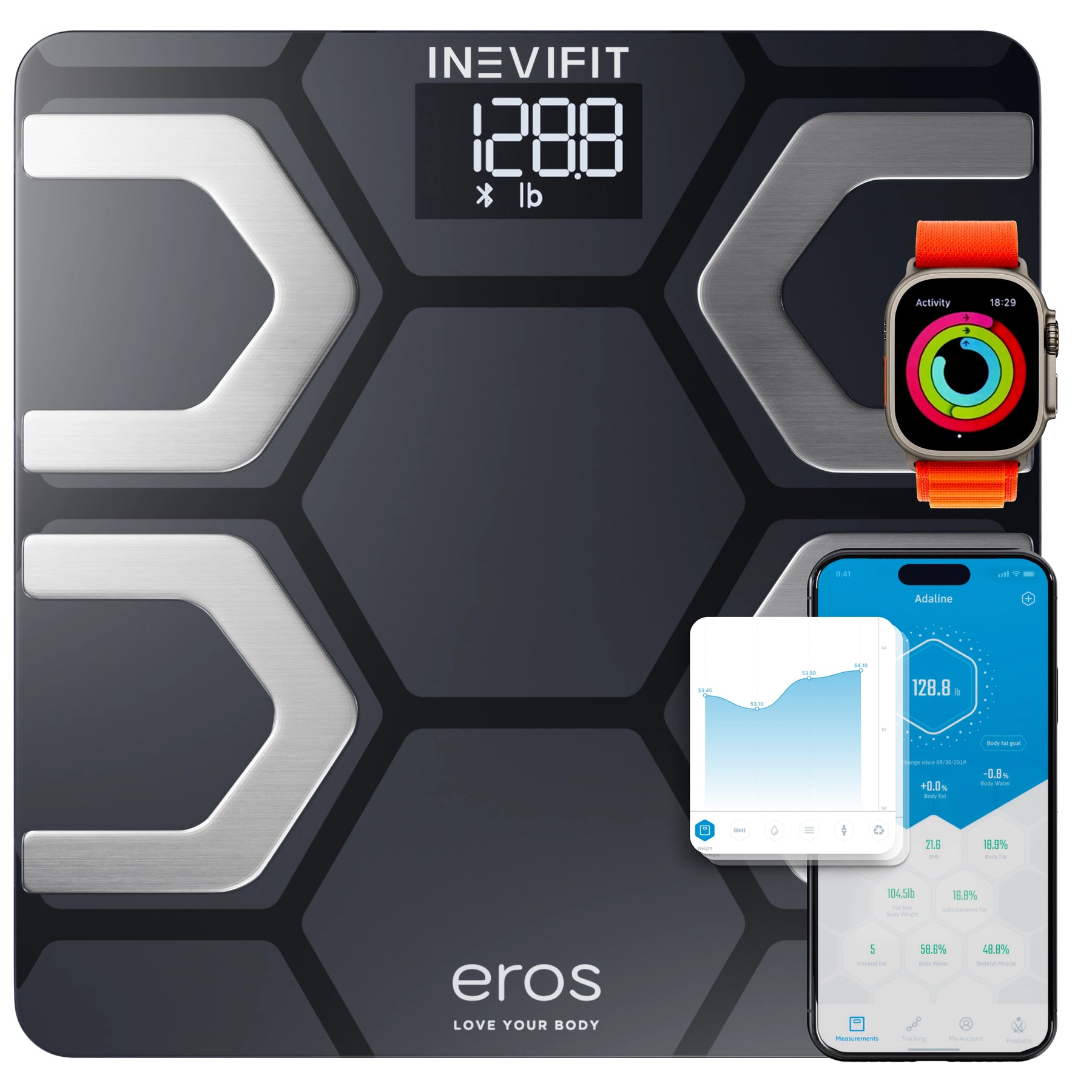
The Eros Smart Body Fat Scale is designed for this type of routine by keeping weight and 12 additional body-composition estimates in one place. The value is not that every reading is clinically exact. The value is that you can use the same method repeatedly and see how your personal trend develops.
A future article in this series, The Best Way to Track Body Composition at Home on a GLP-1, will examine BIA vs. DEXA and other tracking options in more detail.
Reading your data as you go
Collecting numbers is only useful when you know how to read the pattern.
Your data should help you ask better questions, not encourage you to make medication or medical decisions on your own. Look for sustained trends, consider the context around them, and bring concerns about unexpected or significant changes to your healthcare provider.
Fat down, muscle stable or up: body recomposition may be moving in a useful direction
If your body-fat estimate trends downward while muscle-related estimates stay relatively stable or rise, total weight may not tell the full story.
This is the basic idea behind body recomposition: the relationship between fat mass and lean tissue can change even when the scale moves slowly. Because BIA readings fluctuate, look for a sustained pattern rather than celebrating or worrying about a single result.
The series article Body Recomposition on a GLP-1: How to Protect Muscle While Losing Fat will explore this tracking pattern in depth.
Muscle mass trending down: look at the pattern and talk to your doctor
A sustained decline in muscle or lean-mass estimates deserves context. Home BIA cannot determine the cause, and one low reading may simply reflect hydration or measurement conditions.
If the trend persists, discuss it with your healthcare provider. Nutrition and resistance exercise are commonly considered when preserving lean tissue during weight loss, but individual needs can vary, particularly when medication, health conditions, age, or mobility are involved.
For home exercise, INEVIFIT Resistance Bands can be a practical supporting tool for resistance-based movement, but they are not a substitute for individualized medical or training guidance.
Upcoming articles will cover How Much Protein Do You Need on a GLP-1? A Tracking-First Guide and Resistance Training on a GLP-1: How Often, and How to Track If It's Working.
Progress that isn't on the scale at all
Not every meaningful change appears as a lower number.
You might notice changes in how clothes fit, physical capability, consistency with exercise, daily routines, or other personal markers that matter to you. These non-scale victories can provide useful context when body weight is changing slowly or when day-to-day fluctuations make progress harder to see.
The article Non-Scale Victories on a GLP-1: What to Notice Beyond the Number will focus on building a broader progress dashboard.
Weight holding steady?
A weight loss plateau does not automatically mean nothing is happening.
First, widen the time frame. A few stable days are different from a sustained plateau. Then look at body-fat estimates, muscle trends, body water, and your measurement consistency. A flat scale number can sometimes coexist with changes in body composition, while temporary water shifts can also obscure a longer-term trend.
Do not adjust a prescription based on home scale data. Questions about treatment response or medication changes belong with the clinician managing your care.
The dedicated guide GLP-1 Weight-Loss Plateau: What Your Body-Composition Numbers Are Telling You will explain how to read the numbers without overreacting to short-term noise.
Explore the full GLP-1 tracking guide
The goal of this pillar is to give you a framework. Each article in the series goes deeper into one part of tracking weight loss, body composition, and progress beyond the scale.
Understanding the basics
Coming in this series:
- Fat Loss or Muscle Loss? How to Tell What You're Really Losing on a GLP-1
- How Often Should You Weigh Yourself on a GLP-1?
- GLP-1 Weight-Loss Plateau: What Your Body-Composition Numbers Are Telling You
- Body Recomposition on a GLP-1: How to Protect Muscle While Losing Fat
- How Much Protein Do You Need on a GLP-1? A Tracking-First Guide
- The Best Way to Track Body Composition at Home on a GLP-1
Building the plan
- Visceral Fat and GLP-1: Why This Metric Matters More Than the Scale
- Does a GLP-1 Slow Your Metabolism? Tracking BMR, Metabolic Age, and Realistic Pace of Loss
- Non-Scale Victories on a GLP-1: What to Notice Beyond the Number
- Why Your Weight Bounces Around on a GLP-1 (and What to Track Instead)
- Resistance Training on a GLP-1: How Often, and How to Track If It's Working
Special situations
Frequently Asked Questions
Does a GLP-1 cause muscle loss?
Weight loss during GLP-1 therapy can include some lean-mass loss, but the amount varies across studies and individuals, and lean mass is not identical to skeletal muscle. Body-composition tracking can help you watch the overall trend without diagnosing muscle loss at home. See Fat Loss or Muscle Loss? How to Tell What You're Really Losing on a GLP-1.
How often should I weigh myself on a GLP-1?
There is no single weighing frequency that fits everyone. The useful approach is one you can repeat under consistent conditions without overreacting to normal daily changes. Focus on longer-term trends rather than individual readings, and follow any monitoring plan your healthcare provider gives you. See How Often Should You Weigh Yourself on a GLP-1?
What causes a GLP-1 weight-loss plateau?
A flat scale trend can have multiple explanations, including normal short-term weight variation or a genuine slowing in the rate of loss. Home body-composition data may add context, but it cannot determine the medical cause of a plateau or guide medication changes. See GLP-1 Weight-Loss Plateau: What Your Body-Composition Numbers Are Telling You.
How accurate are smart scales for tracking body composition?
Smart scales use BIA to estimate body composition, so they should be treated as trend tools rather than clinical measurements. The Eros Smart Body Fat Scale is specified as measuring body composition within approximately ±3% of DEXA for most users. Consistent conditions and long-term patterns matter most. See The Best Way to Track Body Composition at Home on a GLP-1.
The takeaway: track the kind of change, not only the amount
The scale number is still useful. It just is not the whole story.
A better GLP-1 weight loss tracking routine combines total weight with body-fat, muscle-related, and body-water trends, then gives those numbers enough time to become meaningful. This approach can help you distinguish a longer-term pattern from normal daily noise and create better questions for conversations with your healthcare provider.
The Eros Smart Body Fat Scale brings 13 body-composition metrics into one at-home tracking system, with app trends and synchronization with Apple Health, Google Fit, Samsung Health, and Health Connect. Use it for what BIA does best: building a consistent, repeatable view of change over time rather than chasing a single "perfect" reading.
